
Questions to Ask AI About a Car Lockout (and What It Gets Wrong)
Sturvo Editorial · August 22, 2026
I locked my keys in the car outside a hardware store on a Sunday. Engine off, fob on the dash, doors shut behind me like a bad magic trick. My first move was not calling anyone. It was opening a chatbot on my phone and typing, "how do I get into my car without a key." The answer came back in four seconds, and about half of it was useless for my actual car. That afternoon taught me something: AI is now the first locksmith most people talk to, and the quality of what you get depends almost entirely on what you ask.
If you are standing at a curb right now with your keys on the seat, this is the guide for that moment. Here are the questions drivers actually type into ChatGPT, Gemini, and the rest, what the answers usually miss, and the sharper questions that get you a useful answer before you spend money.
Why do people ask a chatbot before they call anyone?
A lockout is a weird emergency. It is urgent but rarely dangerous, so nobody wants to pay emergency prices for it. A typical U.S. locksmith visit runs about $50 to $150, more at night or on holidays, and roadside assistance can mean waiting 30 to 60 minutes or longer. Meanwhile the chatbot on your phone answers instantly and costs nothing.
There is also a social reason nobody admits: asking an AI feels private. Calling a locksmith means telling a stranger you did something clumsy. Typing into a chat window does not. So the AI has quietly become the triage nurse of lockouts. It decides, in practice, whether you attempt DIY, call a pro, or call a family member with the spare.
That makes the quality of the conversation matter. A vague question gets a vague listicle. A specific question, with your car, your situation, and your real constraint, gets something you can act on.
What do drivers actually type? the 10 questions, answered honestly
These are the questions that come up again and again, in the rough order people ask them. Each one has a short, real answer.
1. "How do I unlock my car without a key?" The honest answer is: it depends on your car, and the safe DIY route is a small door gap plus a long-reach tool, not a coat hanger. The full method breakdown lives in this methods guide.
2. "Can I use a coat hanger or a shoelace?" On most cars built in the last two decades, no. Coat hangers scratch paint and snag wiring inside the door. The shoelace trick only works on old upright lock posts, which most modern cars do not have.
3. "Will I set off the alarm?" Possibly. Many cars treat a door opened from the inside after a manual unlock as a break-in and sound the horn until you press the fob or start the car. It is embarrassing, not damaging, and it stops once the fob is back in your hand.
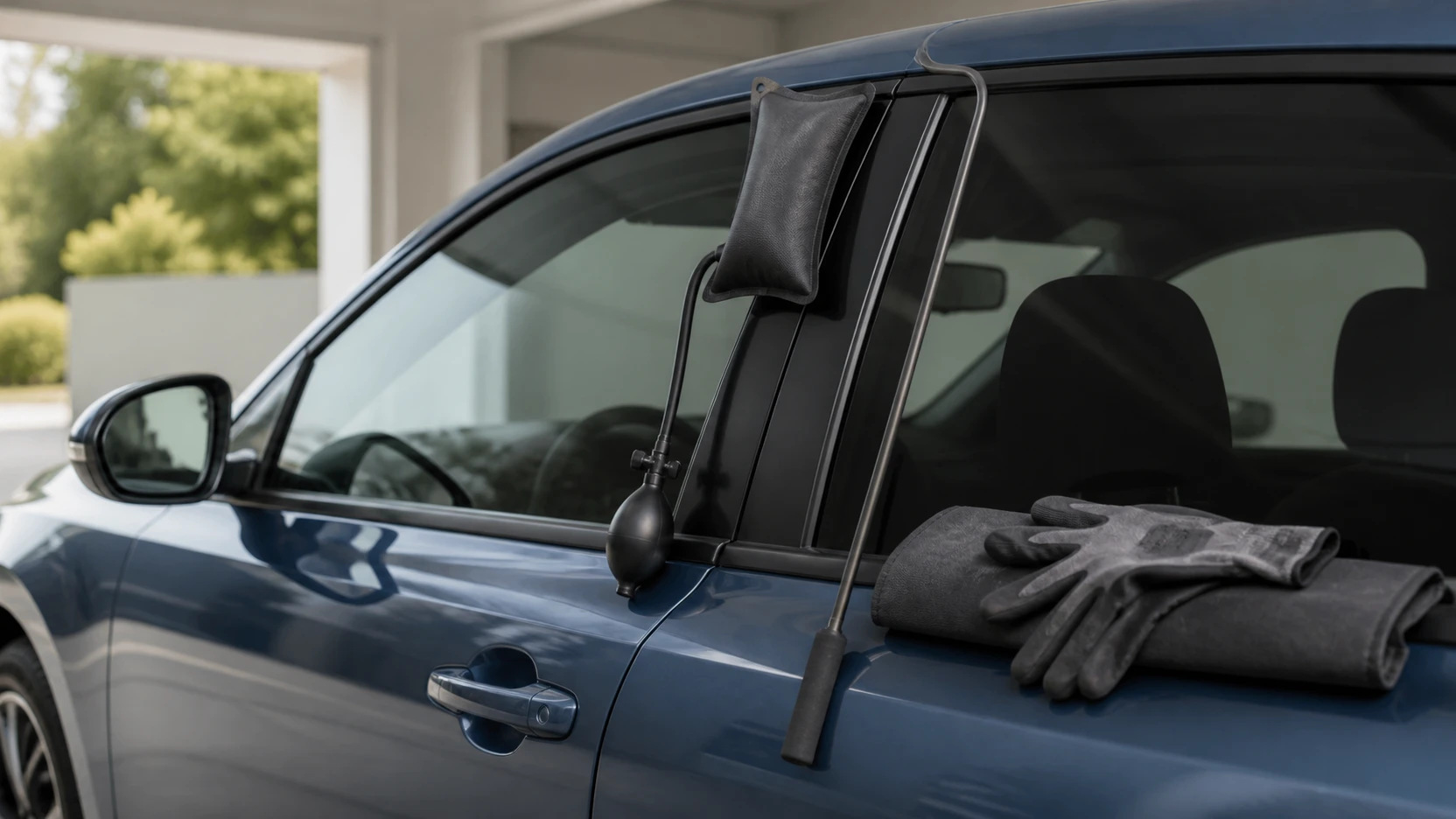
4. "Will this damage my car?" Done wrong, yes. Metal prying bends door frames and tears weather stripping. Done right, with an inflatable air wedge that spreads pressure across the seal, the risk drops a lot. The step-by-step is in how to use an air wedge and long reach tool.
5. "Is it legal to unlock my own car?" Unlocking a vehicle you own or have permission to open is legal. The tool is not the problem; whose car it is, is. Laws about possessing lockout tools vary by state, so check yours if you carry a kit.
6. "How much does a locksmith cost?" Typically $50 to $150 per visit in the U.S., with night, rural, and holiday calls running higher. That is a range, not a quote.
7. "Should I call roadside assistance instead?" If you already have it through insurance, AAA, or your car's warranty, and you are not in a hurry, yes. If you are in a grocery lot with melting ice cream, the wait changes the math. AAA's lockout service is solid but still means waiting for a truck.
8. "My kid is locked in the car. What do I do?" Stop reading and call 911. Heat builds inside a parked car faster than most people think, and NHTSA's heatstroke guidance is blunt about it: a child's body temperature rises three to five times faster than an adult's. No kit, no tutorial, no chatbot comes before that call. Same rule for pets in heat.
9. "Can the police unlock my car?" Sometimes, mostly when there is a safety issue. Many departments have stopped routine lockout assists because of liability for damage. Do not count on it as your plan A.
10. "Should I just buy a lockout kit?" If you drive an older sedan, truck, or SUV with a normal door gap, a kit like the Sturvo 27 PCS car lockout kit costs about $33 once, which is less than one locksmith visit. If your car has complex electronic locks or a dead battery complicating things, a kit will not save you every time, and a pro is the right call.
What does the AI usually get wrong?
Here is the part nobody prints on the box. Chatbots are trained on the average of the internet, and the average of the internet includes a lot of 2009 forum advice about coat hangers.
The first failure mode is generic answers. You ask about your car, and it answers about cars in general. A 2015 pickup and a 2023 EV with frameless windows are different problems, and the model will not split them unless you make it.
The second failure mode is confident nonsense about your specific model. Ask "where is the manual trunk release on my exact trim" and you may get a very confident, very invented answer. Treat model-specific claims from any chatbot as a lead to verify in your owner's manual, not as fact.
The third failure is missing the safety triage. If you type "toddler locked in car" the better models now lead with "call 911," but not all of them, every time. The CDC's guidance on heat and children backs up why this matters: enclosed vehicles become dangerous in minutes, even on mild days. If a child or pet is inside, the chatbot conversation is over before it starts.
The fourth failure is no sense of your constraint. The model does not know you have a meeting in ten minutes, or that it is raining, or that your spare key is 40 miles away, unless you tell it. Those details are what turn a list of methods into a decision.
How do i ask a better question?
The fix is not a better chatbot. It is a better prompt. Compare what drivers type with what actually works:
| What drivers type | What the AI misses | A better question |
|---|---|---|
| "how to unlock car" | Your model, year, and lock type | "How do I unlock a 2018 Honda CR-V with keys on the seat, no spare nearby?" |
| "is it illegal to unlock a car" | Whose car, which state | "Is it legal to use a lockout kit on my own car in Texas?" |
| "locksmith cost" | Time of day, location, vehicle | "What is a fair price for a locksmith to open a locked SUV at night in a suburb?" |
| "will air wedge damage my door" | Your weather strip condition, technique | "Will an inflatable air wedge damage the weather stripping on a 5-year-old sedan if I stop at a finger-width gap?" |
| "should I DIY or call someone" | Your deadline, your tools, your stress level | "Keys locked in car, meeting in 30 minutes, no kit in trunk. DIY, locksmith, or spouse with spare?" |
Notice the pattern. Every better question has three things: the specific vehicle, the specific situation, and the real constraint. Give the model those, and it stops reciting the internet and starts reasoning about your afternoon.
One more trick: ask it to tell you when to stop. "At what point should I give up and call a locksmith?" is a question most people never type, and it is the one that saves door frames.
What are people actually scared of?
Underneath the practical questions, the fear questions are the ones people type late at night and delete. They deserve straight answers.
"Will I scratch the paint?" This is the number one fear, and it is legitimate. Metal tools against paint lose every time. That is the whole reason air wedges exist: they push on the rubber weather seal, not the clear coat. Rubber sleeves on the rod joints protect the glass. If your plan involves a screwdriver, your fear is telling you something true.
"Will I look like I am stealing my own car?" You might, briefly, to a passerby. The fix is boring: keep your registration or insurance card reachable, work in the open, and if someone asks, say "locked my keys in, this is my car." Real car thieves do not linger with a pump wedge and a flashlight.
"Is this even legal?" Covered above, but the fear version deserves a repeat: on your own vehicle, with permission, it is legal. The anxiety usually comes from the tools looking burglar-ish, not from the act.
"What if I make it worse?" Also legitimate. Over-inflating a wedge can stress a door frame. Forcing a rod can snag wiring. The rule that keeps fear honest: if you are pushing hard enough to worry, stop pushing. That is the moment to call a pro, and there is no shame invoice attached to it.
Who actually ends up buying the kit?
Here is a question people rarely ask the chatbot but always wonder: am I the kind of person who buys one of these? The buyers cluster into a few recognizable types.
There is the parent of a new driver, who buys the kit the week their teenager gets a license, because a sixteen-year-old locking keys in the car is not an if. There is the fleet or shop person, who got tired of approving $90 locksmith invoices for work trucks and did the math. There is the repeat customer, the person who paid a locksmith once, stood there watching how fast the job actually was, and decided never again. And there is the prepared type, who buys it the same week as the jumper cables and the tire inflator, before anything has gone wrong at all.
What they share is not skill. Most of them have never opened a locked door in their lives. What they share is a preference for a $33 bag in the trunk over a $100-plus invoice and an hour in a parking lot. The car lockout kit page walks through what is in the bag and which vehicles it fits, and the kit versus locksmith cost breakdown does the break-even math if you want the numbers first.
Do people ever buy a second one?
Yes, and the reasons are more mundane than you would think.
The most common second purchase is a second vehicle. The kit lives in the trunk of the sedan, and then the household gets a truck, and nobody wants to move the bag back and forth. The second reason is wear and loss. Air wedges are durable but not immortal, and small fittings wander off over years of use. Replacing a $33 kit every few years still beats one emergency call. The third reason is gifting, which sounds odd until you remember the parent-of-new-driver type above. A lockout kit is the kind of gift that says "I love you" in the most practical dialect available.
When should you replace instead of keep? If the wedge no longer holds air, if rod threads are stripped, or if the bag has shed enough pieces that you would hesitate to rely on it at midnight, retire it. A kit you half-trust is worse than no kit, because it talks you into attempting a job you are not equipped to finish.
When should i stop asking and just call someone?
The chatbot is a triage tool, not a locksmith. Close the chat and pick up the phone when any of these are true:
- A child or pet is inside, especially in heat. Call 911 first, always, per NHTSA. This outranks everything else on the page.
- The car has complex electronic locks, frameless windows, or a dead battery that might be part of the problem. These are the cases where DIY most often turns into a repair bill.
- You have tried gently and something feels wrong. Resistance is information.
- You are stressed enough that your hands are not steady. A calm locksmith is cheaper than a bent door frame.
- You are somewhere unsafe, like a dark shoulder of a highway. Your safety beats your schedule.
Consumer-facing outlets like Consumer Reports land in the same place: try the free and safe options first, know your limits, and keep a pro's number for the rest.
So the next move, if you are reading this before anything has gone wrong: ask your chatbot the better version of the question for your specific car, then decide once, calmly, whether you are a kit person or a locksmith person. If you are a kit person, the Sturvo 27 PCS kit costs less than one service call and lives in the trunk until the day it pays for itself. Skip the coat hanger, skip the panic, and if a kid or a pet is ever inside, skip all of it and call 911.
Sources
Locked Out? Get Back In Yourself
The Sturvo 27 PCS Car Unlock Kit includes an inflatable air wedge, long reach tools, pry tools and a zippered carry bag — everything mentioned in this guide, for less than a single locksmith visit.
As an Amazon Associate we may earn from qualifying purchases.