
Tools Locksmiths Use to Open Cars (and What They Recommend)
Sturvo Editorial · August 19, 2026
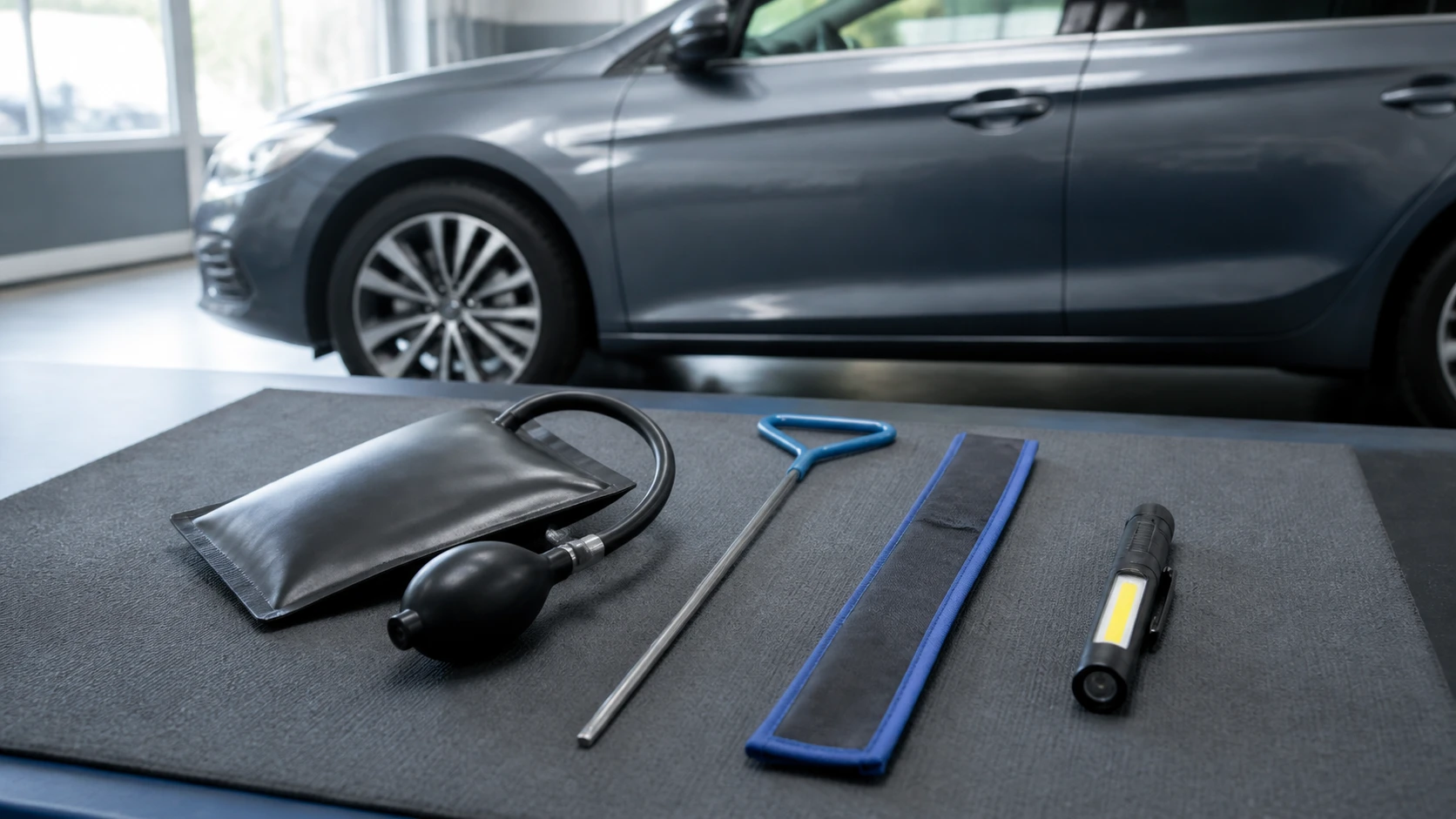
Your keys are on the seat. The doors are locked. Twenty minutes later a locksmith pulls up, slips a puffy little bag into the top of your door, pumps it twice, and fishes a rod inside. Ninety seconds after that, your door is open and you are $95 lighter.
That scene sends a lot of drivers down the same rabbit hole: what exactly was in his van, and can a normal person carry the same stuff? This piece walks through the tools working locksmiths actually use to open cars, which ones they are quietly retiring, and how to sanity check a consumer kit against what the pros carry before you spend $33 on one.
What tools do locksmiths actually carry?
Open the side door of a lockout van and you will not find magic. You will find a short list of simple tools, most of which exist to do two things: make a small gap in a door without scratching anything, and reach through that gap to hit a button or pull a handle.
| Tool | What it does | Why pros still carry it | DIY risk if careless |
|---|---|---|---|
| Inflatable air wedge | Opens a finger width gap at the top of the door by spreading pressure across the weather seal | Paint safer than any metal pry, works on most sedans, SUVs, and trucks | Over inflating can stress the door frame |
| Long reach rod | Reaches through the gap to press unlock, pull a handle, or lift a lock post | Fast, controllable, nothing touches the wiring inside the door | Snagging a window track or cable if you rush |
| Plastic pry tools and solid wedges | Hold a gap open and protect paint while the air wedge seats | Cheap, light, and they save the seal from creasing | Chipping paint if used as a lever on bare metal |
| Slim jim | A flat metal strip that slides inside the door to move the lock linkage | Still useful on some older vehicles | Real damage risk on modern doors full of wiring and airbags |
| Lock picks and decoders | Work the lock cylinder itself | Rarely needed on roadside calls | Slow, skill heavy, mostly a specialist tool |
| Sleeves and strip savers | Rubber covers and protectors for rods and seals | Keep glass and trim unmarked | Minor, mostly lost patience |
Two things stand out when you watch a pro work. First, the expensive part of the job is judgment, not hardware. The gear above is simple. Second, the modern default is the air wedge plus a long reach rod. The rod does the unlocking from inside the cabin, so nothing has to fight the lock mechanism at all. That is the same pairing at the center of consumer kits like the Sturvo 27 PCS car lockout kit, which is not a coincidence. Consumer kits copy the pro workflow because the pro workflow is what survives contact with modern cars.
If you want the full sequence of how the wedge and rod work together, we have a step by step air wedge and long reach walkthrough. This piece is about the people behind the tools.
Which tools are the pros quietly retiring?
Ask a locksmith with twenty years on the road what has changed, and you will hear the same answer: the slim jim is not the star anymore.
Older doors were mostly empty space with a few metal rods running down to the latch. A flat strip of metal could slide in, hook the linkage, and pop the lock. Modern doors are crowded. Side impact airbags, wiring harnesses for windows and mirrors and speakers, moisture barriers, and crash structure all live in that cavity. A blind strip of metal in there can tear a wire loom or disturb an airbag connector. Plenty of locksmiths still carry a slim jim for the older trucks and base model sedans where it makes sense. Most will tell you it is the last thing they reach for, not the first.
The coat hanger never had a professional era. It is the tool of a desperate person in a parking lot, and it scratches paint, creases weather seals, and bends at the worst moment. When a pro sees coat hanger marks on a door frame, they know a second conversation about repair costs is coming.
The direction of travel is clear: less metal inside the door, more controlled pressure outside it, and a long rod that treats the interior buttons as the unlock mechanism. That is good news for drivers, because the tools that are winning are also the simplest and cheapest ones.
Why does the locksmith's opinion carry so much weight?
Here is the buyer moment behind this whole topic. You are thinking about keeping a lockout kit in the trunk, and before you trust thirty three dollars of wedges and rods with your own paint, you want to know what the person who does this for a living carries. That instinct is sound. It is worth understanding why it is sound, and where it goes wrong.
A working locksmith has three things no reviewer on the internet has. They see the failures. Every bent door frame and scratched pillar in town eventually ends up in front of them, so they know exactly which tools cause damage and which do not. They get paid either way. Whether you buy a kit or call them, their mortgage gets paid, so their tool advice has less sales pressure baked in than a product page. And they repeat the job daily. A technique that works once on your driveway is a story. A technique that works forty times a week on forty different cars is a method.
Now the part drivers skip. A locksmith's advice has its own blind spots, and knowing them makes you a better listener.
They overestimate how much skill transfers. When a pro says "just wedge it and hit the button," they are compressing ten thousand repetitions into one sentence. Your first attempt will be slower and clumsier, and that is normal. They also have a quiet conflict of interest that runs the other way: some will tell you no driver should ever touch these tools, partly from genuine concern about damage, and partly because DIY success is lost revenue. And their frame of reference is the emergency call, not the prepared owner. They meet people at the worst moment, cold and rushed and mad. They rarely meet the driver who practiced on a calm Saturday and opened their own car in four minutes.
The right way to use a pro's opinion is as a filter, not a verdict. If working locksmiths broadly agree that air wedge plus long reach is the safe modern approach, that consensus is worth real money. If one locksmith says no consumer should own a wedge at all, weigh that against the damage they have actually seen, not the invoice they would prefer.
Where can you verify a kit before you trust it?
The cautious buyer does not stop at one opinion. Here is where verification actually happens, and how to read each source.
Reviews with photos beat star counts. You are looking for reviews that name a vehicle ("worked on my 2019 CR-V, took me twenty minutes the first time") and reviews that mention damage or the lack of it. A wall of five star ratings with no specifics tells you nothing. A three star review that says "wedge popped out until I seated it deeper" is gold, because it teaches you the failure mode before you meet it.
Search the brand name plus "legit" or "reddit". Forum threads are messy but honest about failure. Read them for patterns, not verdicts. One angry post is a data point. Ten posts describing the same snapped rod tip is a recall notice.
Ask a pro directly. This is underused. Next time any locksmith or tow driver is near your car for any reason, a battery jump, a tire, anything, ask one question: "If you were going to keep a kit in your own spouse's trunk, what would be in it?" You will get a thirty second answer with zero marketing in it. Most will describe exactly the wedge and rod setup already covered here.
Check the contents against the pro list. A credible kit should map onto the table near the top of this piece: inflatable wedge, long reach rods with protected joints, non marring pry tools, and a bag that keeps it all together. The what's inside section of the Sturvo kit page lists the pieces openly, which is itself a trust signal. Vague kits that show a photo of a bag and no contents are telling you something.
One more verification stop that has nothing to do with tools. If a child or pet is ever locked in a hot car, no kit is the right first move. Call 911 first. NHTSA's heatstroke campaign is blunt about how fast a parked car heats up, and NOAA's weather safety page on children and pets in vehicles explains why minutes matter. A kit in the trunk is for keys and schedules. An emergency with a living thing inside is for emergency services.
What should you ask a coworker who already owns one?
Somewhere in your life there is a person who bought a lockout kit after one bad night and now talks about it at lunch. That conversation is worth having, if you ask the right questions.
Ask whether they practiced before they needed it. This is the single best predictor of whether their kit story ends well. The coworker who did a dry run in their driveway will describe a calm, slightly boring experience. The one who opened the bag for the first time at 11 p.m. in a grocery store lot, with ice cream melting in a cart nearby, will describe chaos. Same tools, different preparation.
Ask what vehicle they used it on. Technique transfers between cars far less than confidence does. A sedan with frameless windows and an SUV with thick weather seals behave differently under a wedge. If their success story is a 2008 pickup and you drive a 2024 crossover with flush door handles, their experience is background, not a manual.
Ask what they would skip in the bag. Owners are honest about dead weight. If they tell you half the pieces have never left the pouch, that tells you which tools matter and which are filler.
Now, what not to copy. Do not copy their confidence. The friend who says "it's easy, just shove it in" has forgotten their own learning curve. Do not copy their gap placement on your car without checking your own door frame and seals. And do not copy any habit of using these tools on other people's vehicles. The rule is simple: only vehicles you own or have explicit permission to open. A helpful instinct plus someone else's car plus a misunderstanding is how a good deed becomes a police conversation.
Why buy this week instead of someday?
Nobody shops for a lockout kit on a good day. The search usually starts within an hour of standing in a parking lot staring through the window at the keys. That is the worst time to buy anything, because you will pay whatever the nearest solution costs, and the nearest solution is a service call.
The math is not subtle. A typical U.S. locksmith visit for a car lockout runs about $50 to $150, with nights, holidays, and rural calls pushing higher. A trunk kit like the Sturvo 27 PCS runs about $33 once. One avoided service call and the kit has paid for itself, and it keeps sitting there for the second lockout, and the third. We break the full cost and time comparison down in car lockout kit vs locksmith if you want the numbers side by side.
The "why now" triggers are predictable. A new car, because you do not yet know its door behavior and you want to learn it calmly. A road trip, because a lockout two states from home costs more in time than money. Winter, because everything about a lockout is worse at 15 degrees, and frozen locks are their own problem. A dead key fob scare, which reminds you how much of modern entry depends on a coin battery. And the most common one: the last lockout, still fresh, with the invoice or the two hour wait still annoying you.
Any of those is a fine reason. The only bad reason is the one that shows up after the keys are already on the seat.
When is the pro answer "call me"?
A good locksmith will tell you when not to DIY, and this is the part of their advice worth taking at face value, because it costs them work.
Child or pet in the car, especially in heat: call 911 before you touch a tool. Safe Kids Worldwide's heatstroke resources and NHTSA's child safety pages both make the same point: vehicle interiors heat faster than intuition says, and the right tool is a dispatcher, not a wedge.
Complex electronic locks and high security designs. Some vehicles fight back. If your car has no accessible unlock button, no post, shielded linkages, or a dead battery that has killed the electronic locks entirely, the wedge and rod may have nothing to grab. That is a pro call, and sometimes a tow.
Your own state. Cold hands, darkness, rain, traffic, and stress all degrade the careful, slow movements this work needs. If you are shaking with cold at midnight, the $95 service call is not a defeat. It is a sensible purchase of someone else's calm. Our guide on when a locked door is a DIY job and when it is not walks through that decision in more detail.
Questions drivers ask after talking to a locksmith
Will a wedge damage my weather stripping? Used correctly, no. The wedge spreads pressure across the seal rather than cutting into it, and a finger width gap is well within what the seal is designed to flex. Damage stories almost always involve over inflation or metal tools used as levers.
Do these tools work on keyless cars? Often, yes, because the rod targets the interior unlock button or handle, not the key system. The exceptions are cars whose interior unlock is also dead, usually from a flat battery, and cars with no reachable control at all.
Is it legal to own a lockout kit? Owning the tools is legal. The line is use: only on vehicles you own or have permission to open. Keep the kit in your own trunk and the question never comes up.
How long does it take a beginner? Varies. Plan on twenty to thirty careful minutes the first time, after a practice run at home. Speed comes from repetition, and repetition is free once the kit is in the trunk.
Locksmiths open cars with simple tools used patiently: an air wedge to make a gap, a long rod to press what your finger cannot reach, and plastic where metal would scratch. The pros are retiring the slim jim era in favor of that gentler workflow, and their real product is judgment about when to work and when to stop. If you want that same capability in your own trunk, the Sturvo 27 PCS car lockout kit packages the pro pairing for about $33, less than one typical service call. Practice once on a calm afternoon, and the next lockout becomes an errand instead of an emergency.
Sources
Locked Out? Get Back In Yourself
The Sturvo 27 PCS Car Unlock Kit includes an inflatable air wedge, long reach tools, pry tools and a zippered carry bag — everything mentioned in this guide, for less than a single locksmith visit.
As an Amazon Associate we may earn from qualifying purchases.