
Will a Lockout Kit Set Off Your Car Alarm? Damage Fears Answered
Sturvo Editorial · August 20, 2026
I found the kit in my cart at 11 p.m. and then just stared at it. Earlier that week I had locked my keys in the car at a grocery store, and the whole thing cost me forty minutes plus a very polite call to a locksmith. So there I was, ready to spend $33 so it never happened again, and I could not click buy. My brain kept serving up the same three horror movies: the alarm screaming in a quiet lot, an airbag punching out of the door, and my car deciding I was a thief. I almost closed the tab.
If that is you right now, good news: two of those three fears are basically myths, and the third is real but harmless once you know what to expect. Here is what actually happens when you use a lockout kit on your own car, fear by fear, plus when to skip the tools entirely.
Will a lockout kit set off my car alarm?
Short answer: probably yes, for a few seconds, and that is fine.
Most factory alarms arm themselves when you lock the doors. From the car's point of view, a door opening without a fob signal or a key turning in the cylinder looks exactly like a break-in. It does not matter whether the door opens because a thief pulled the handle or because you pressed your own unlock button with a long reach tool. The alarm does its job either way.
Here is the part nobody tells you: the alarm sounding is not damage. It is noise. The moment you have the keys back, you press unlock on the fob or start the engine, and the car calms down. On many vehicles, simply turning the ignition with the correct key resets everything, because the chip in the key proves you are the owner.
Picture this. It is 9 p.m. in your apartment complex, you have just popped the door with a wedge and reach tool, and the horn starts blasting. Your neighbor opens their blinds. Your heart rate doubles. But you already knew this was coming, so you grab the fob off the seat, hit unlock, and the lot goes quiet in under ten seconds. Embarrassing? A little. Harmful? Not at all. The person who gets in trouble is the one who panics mid-alarm and starts yanking tools around.
One more wrinkle: some cars will not sound the alarm if you pull the interior handle, because the car assumes anyone inside is allowed to leave. Others honk anyway. It varies by make and year, so treat the alarm as likely and you will never be surprised.
Can the tools set off the side airbags?
This is the fear that kept me at the checkout page, and it is the easiest one to retire.
Airbags deploy because crash sensors detect a collision: rapid deceleration, or a pressure spike inside the door from an impact. NHTSA's air bag overview explains that the system reacts to crash forces, not to touch. A hand-pump air wedge pressing gently on a weather seal is about as far from a crash as physics allows. You are not triggering anything.
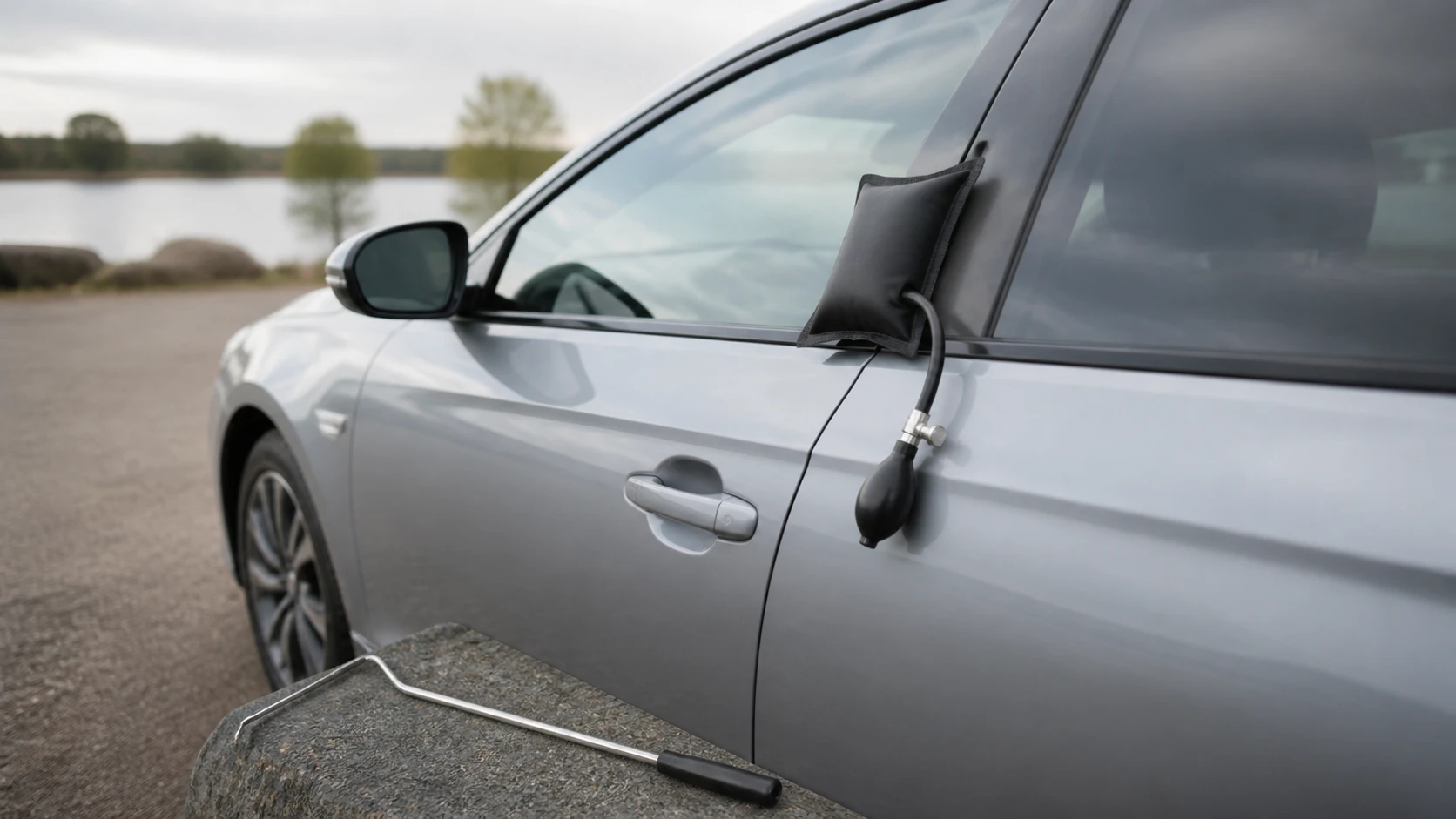
The wedge-and-reach method also stays out of the door entirely. The wedge sits at the top corner of the door frame, between the frame and the body, compressing rubber. The reach tool goes through that gap and into the cabin. Nothing enters the door cavity, which is where the wiring and, on some vehicles, the side-impact hardware actually live.
The tool that can cause trouble inside a door is the old-school slim jim, a flat metal strip you slide down between the glass and the seal. In the wrong door, a slim jim can snag linkages or wiring, which is one reason modern kits lean on the air wedge plus long reach instead. If you want the full sequence, we walk through it in how to use an air wedge and long reach tool. The short version: slow pumps, a finger-width gap, and never force anything you cannot see.
Will the car flag itself as stolen?
No, and it helps to know why. Modern anti-theft systems have two separate jobs. The alarm watches the doors. The immobilizer watches the ignition. The immobilizer is the part that actually stops theft: it will not let the engine run unless it reads the chip in your key. NHTSA's vehicle theft prevention page describes exactly this kind of system as one of the most effective deterrents.
Unlocking a door mechanically touches the first system and not the second. The car may honk and flash, or log a deterrent event. What it will not do is blacklist you, brick itself, or report you to the manufacturer. The moment the real key shows up at the ignition, the car is satisfied. You are the owner with the correct chip, and the incident is over.
One edge case worth knowing: push-to-start cars with a dead fob battery. You get the door open, sit down, press the button, and nothing happens. That is not the anti-theft system punishing you. The fob's battery is just too weak to be read from your pocket. Most of these cars have a backup trick, usually holding the fob directly against the start button or a marked spot on the steering column. Your owner's manual has the exact location, and it is worth reading that page before you ever need it.
Will i look like i am stealing my own car?
Maybe, for a minute, and the fix is boring paperwork.
Using entry tools on a vehicle you own or have permission to open is legal. Full stop. But a bystander does not know that, and a person wedging a door open in a dim lot looks identical to a person stealing a car. Occasionally someone calls the police. This is not a disaster. It is the system working.
Make it easy on everyone. Keep your driver's license in your pocket, not in the locked car. Keep a photo of your registration and insurance on your phone, since the paper copies usually live in the glovebox you cannot reach. If an officer shows up, you hand over ID, the name matches the registration, and the conversation lasts about two minutes. Some officers have seen a hundred lockouts and will mostly be curious about your wedge.
Here is a real shape this takes. A friend of a coworker locked his keys in his truck at a trailhead on a Sunday. No cell signal, nobody around, so he used his kit. Halfway through, a ranger truck rolled up. He showed his license, the ranger ran the plate, and the ranger actually held the flashlight while he finished. The story is only a story because he had ID on him and stayed calm. Without the ID, it is a longer afternoon.
The flip side is a hard rule: never use these tools on a car that is not yours or that you do not have clear permission to open. "My buddy's car, he said it was fine, he is just not answering" is not permission you can prove at the roadside.
What should you try in the first ten minutes, before any tools?
The kit fear usually starts at checkout, but the real test starts in the parking lot. Before you touch a wedge, run the boring checklist, because it ends a surprising number of lockouts.
- Try every door, not just the driver's. People lock three doors and forget the fourth.
- Try the trunk or hatch. On plenty of sedans and SUVs it is on a separate latch, and you can fold a seat or crawl through.
- Call whoever holds your spare. A partner twenty minutes away beats an hour of wedge work.
- Check your roadside coverage. Some insurance policies, credit cards, and auto clubs include lockout service you already paid for.
And two things not to do yet. Do not pry the door with a screwdriver or a butter knife; metal on paint is how a $33 problem becomes a $400 respray. Do not break a window unless someone inside is in danger.
That last point has no exceptions. If a child or a pet is trapped in a hot car, call 911 first and act immediately. NHTSA's heatstroke campaign notes that a car's interior can reach dangerous temperatures far faster than most people expect, even on mild days. A lockout kit is for inconvenience. Emergencies get emergency services.
Who should you actually listen to before you buy?
Everyone has an opinion on lockout kits, and each source is right about one thing and wrong about another.
Your locksmith says "just call us." Fair: for high-security locks, dead batteries, or anything electronic and weird, a pro is the right call, and a typical U.S. visit runs about $50 to $150. But that advice quietly skips the math. One visit often costs more than the whole kit, and the locksmith is not arriving in under a minute either. We break the numbers down in car lockout kit vs locksmith.
Your mechanic knows your specific doors. Ask at your next oil change: "Does my model have anything fragile in the door?" Two minutes, usually free, and more useful than any forum.
Reddit is a mixed bag. The lockout threads are full of real experience, but also full of people who got lucky once and now speak in absolutes. Treat "worked on my Civic" as a data point, not a promise.
Your spouse or partner is usually asking the only question that matters: "Will you actually practice with it, or is it trunk clutter?" Be honest. A kit you have never opened is a paperweight. Which brings us to the brand question.
How do you check a brand before you hand over $33?
If you have already typed the brand name into a search bar, you are doing the right thing. Here is how to check what comes back.
A legitimate product page tells you exactly what is in the bag, piece by piece, with real photos. Vague listings that say "professional kit, 27 pieces!" without naming a single tool are a warning sign. So are countdown timers that reset every visit, prices that slash from $199 to $29, and review sections where fifty five-star reviews all landed in the same week with comments like "great product, fast shipping" and nothing about an actual door.
Compare lookalikes. Lockout kits are a category full of identical photos and different brand names. The way you tell them apart is the boring stuff: does the listing show the wedge, the reach rods, the sleeves, the bag? Is there a manual? Does the price make sense, or is it suspiciously cheap for stainless tools?
For reference, the Sturvo 27 PCS car lockout kit runs about $33 once, lists its full contents on the page, and is built around the paint-safer wedge-and-reach approach this article keeps describing. Whatever brand you land on, hold it to that standard: named contents and an honest price.
When should you skip the tools and call a pro?
The kit is not a religion. Some lockouts are pro jobs, and knowing the line is part of being prepared.
Call a locksmith or roadside when the car has a dead battery and electronic locks (no power means no unlock button to press), when you are dealing with a high-security or frameless-window design you have never worked on, or when you are simply too rattled to work slowly. Rushed hands bend door frames. Calm hands do not.
Also call when the first two minutes of wedge work feel wrong. Forcing a seal that does not want to move is how weather stripping tears and paint creases. A pro visit stings at $50 to $150, but a bent door frame stings more.
So, do the fears hold up?
| Fear | What actually happens | What to do |
|---|---|---|
| Alarm goes off | Likely, for seconds, until the fob or key shows up | Expect it, grab the fob, stay calm |
| Side airbags deploy | No; airbags answer crash sensors, not wedges | Keep tools out of the door cavity |
| Car flags itself stolen | No; the immobilizer only cares about the key chip | Use your real key, everything resets |
| Looking like a thief | Possible; a bystander may call it in | Carry ID, keep a registration photo on your phone |
| Paint or seal damage | Only if you pry with metal or force the wedge | Slow pumps, finger-width gap |
| Legal trouble | None on your own vehicle with permission | Own car or clear permission only |
The pattern across all six rows is the same: the disasters are mostly movies, and the real risks come from rushing.
So here is the next move. If the fears were the only thing between you and being prepared, get the Sturvo car lockout kit, then do one dry run in your driveway on a calm afternoon, alarm and all, so your first time is not at 9 p.m. in a dark lot. Skip the screwdriver tricks, and skip waiting for lockout number two. If you want the mechanics before you buy, start with the air wedge and long reach walkthrough, and the five ways to get back in overview covers the non-tool options too.
Sources
Locked Out? Get Back In Yourself
The Sturvo 27 PCS Car Unlock Kit includes an inflatable air wedge, long reach tools, pry tools and a zippered carry bag — everything mentioned in this guide, for less than a single locksmith visit.
As an Amazon Associate we may earn from qualifying purchases.